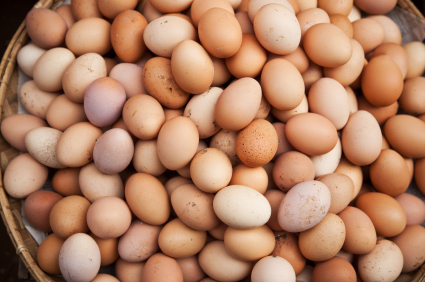
I think everyone should learn how to cook eggs perfectly at home. Eggs are a simple, nutritious and filling meal that’s ideal for those times when you want a meal ready in minutes. There’s nothing better than a creamy scramble or a poached egg with silky yolk dripping out onto warm buttery toast.
Here are a few tips on how to cook eggs.
Choosing eggs
Buy the best eggs that you can afford. I always opt for free-range eggs. Free-range eggs have loads more flavour and brighter yolks than eggs that come from intensively farmed hens.
Testing for freshness
It’s always best to use fresh eggs. You can test for freshness by placing an egg in a bowl of water—a fresh egg will sit on the bottom of the bowl, older eggs float. This occurs because eggs have a porous shell and moisture escapes as they age, shrinking the contents and increasing the air pocket inside. Any eggs that float should be thrown away.
Cooking methods
Boiling
How to cook eggs by boiling depends on whether you like the yolks runny or firm.
Start by removing your eggs from the refrigerator and allowing them to come to room temperature. Still cold eggs will crack when boiled.
To soft boil—Fill a saucepan with enough water so that it will generously cover the eggs when they’re added. Add a small sprinkle of salt and bring the water to the boil. Reduce the heat to a gentle boil and slip the eggs into the water using a spoon. Gently boil the eggs for:
- 3 minutes if you want very soft yolks and partially set whites
- 4 minutes for still-soft yolks and fully set whites
- 5 minutes for firm yolks and whites.
To hard boil—Place the eggs in a saucepan of cold water and allow it to come to the boil. Once the water is boiling, continue to cook the eggs for 8–10 minutes.
Drain your eggs and run them under cold water to stop cooking process, then peel away the shells and serve.
My favourite way to boil eggs is using the hard-boiled method but not cooking the eggs for quite as long. I follow the same process but take them out of the boiling water after 4 minutes. The white is set and the yolk is set but still dark and moist, not firm and grainy as hard boiled-egg yolks can be.
Frying
How to cook eggs by frying is fairly straightforward because you can see how the egg whites and yolks are changing as they are being cooked. Once again, the cooking time will depend on how hot your frypan is and how you like your eggs.
Bring your eggs to room temperature prior to cooking. Heat a little butter or olive oil in a non-stick frypan over medium heat—butter or oil lightly sizzling. Gently crack each egg (you don’t want to rupture the yolk) and slowly pour them into the frypan one at a time. If the white starts to bubble and pop, reduce the heat. By cooking eggs gently they will be tender. Allow to cook to your liking. My preference is for a set egg white with a still-runny yolk, which takes 2–3 minutes. If you want a completely cooked white and yolk either flip the egg to cook the other side, or add a teaspoon of water the pan and cover (this will steam the egg).
If you’re cooking bacon to have with the eggs, make sure you cook the bacon first and allow the frypan to cool down to medium before adding butter or oil for frying the eggs. If you crack your eggs into a too-hot pan the whites spread and turn crisp.
Poaching
How to cook eggs by poaching is a little tricky to get right. Practice helps and it’s definitely a cooking skill worth learning—a properly poached egg is wonderful to eat.
- Fill a small saucepan with approximately 10cm of lightly salted water and heat until simmering.
- Gently break your egg into a cup without breaking the yolk.
- Stir the simmering water with a spoon to create whirlpool. Pour your egg into the centre allow to cook for 3–4 minutes until the white is set. The initial whirlpool helps the egg stay in a roughly round shape.
- Using a slotted spoon, remove the egg from the water and drain briefly on a clean tea towel.
- Serve immediately.
If you are poaching a few eggs then follow the instructions above for each egg, leaving them to drain on the tea towel. You can then reheat them just before serving by placing them on the slotted spoon and holding them in the simmering water for up to a minute. Remove the eggs from the water, drain them briefly and serve.
Scrambling
How to cook eggs by scrambling is quite easy. It just takes a little bit of patience for slow cooking on gentle heat and constant stirring to reach that beautiful creamy consistency.
The importance of stirring scrambled eggs should not be underestimated. If you want moist, creamy eggs, you need to stir them frequently so that the egg can’t set on the bottom of the pan. If you leave the egg for too long without stirring you’ll end up with large, dry curds of egg.
For soft, moist just-cooked curds try my recipe for scrambled eggs.
Making omelettes
How to cook eggs in an omelette is very quick and you can add whatever you like for the filling. Our way of making omelette is not traditional, but it works for a tasty meal for two. We like cheese, ham and tomato.
You will need:
20g butter
4 eggs
50g cheese cut into small 7mm cubes
50g sliced ham cut into ribbons
1 tomato, diced
herbs, finely chopped – we use garlic chives, basil or parsley
Method:
- Crack the eggs into a small bowl, whisk lightly—you want to retain some marbling of the yolks and whites in the omelette.
- Melt butter in a non-stick frypan (26–28cm) over medium heat. When the butter is bubbling, add the eggs and tilt the frypan so you have a layer of egg across the bottom.
- Working quickly (before the egg is set), add cheese cubes evenly across egg mixture.
- On one half of the omelette add the ham and diced tomatoes.
- When the egg is just setting but still a bit runny, fold the empty half of the omelette on top of the filled half to produce a calzone.
- Flip the calzone in the pan so that the omelette settles on the other side.
- Remove from heat immediately so that omelette finishes cooking using only residual heat from the frypan—the centre should be just slightly runny.
- Serve immediately sprinkled with the fresh herbs.
Making custard
Smooth rich custard is such a pleasure to eat. With a little time and care, home-made custard can lift a good dessert to dazzling new heights of flavour. Its texture and taste simply cannot be compared to the store-bought ones. Here’s our custard recipe.