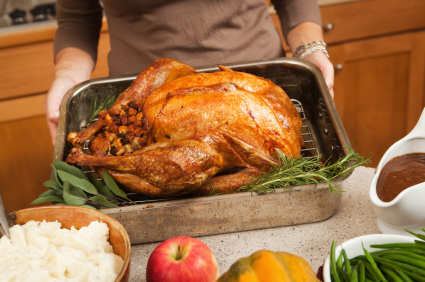
Learning how to cook turkey is a bit of a challenge in getting the meat cooked perfectly. Turkeys have two types of meat—the tender breast and the tougher leg meat—each requiring different cooking times to bring out the best texture and flavour.
Here are a few tips and tricks on how to cook turkey.
What you’ll need:
- Large baking tray, preferably with a wire rack that fits in the bottom
- Foil
- Turkey baster or large pastry brush
- Meat thermometer or metal skewer
- Sharp carving knife and fork
Choosing the right turkey size
In terms of how to cook turkey, the first thing to think about is the size of the bird you need. Choosing the right size depends on a few things:
- the number of people eating turkey
- the preferred kind of turkey meat—breast or thigh
- available space in your refrigerator
- size of your oven.
To determine the size of turkey to buy based on the number of people eating, you need to allow approximately 300–350g (12oz) per person for a whole bird, or approximately 200g (7oz) for a rolled breast.
If your guests are only going to eat the breast meat it might be worth considering buying a buffe—a turkey on the bone but with the legs removed—or rolled breasts.
You will need to store and defrost your turkey in the refrigerator, along with all the other goodies it’s being served with, so make sure that you have enough space for everything.
Finally, the size of your oven is critical. Turkeys are large birds. You need to consider whether you’ll have enough room, not only for the turkey, but for roast vegetables as well.
Preparing the turkey
Part of how to cook turkey is preparing the bird before it goes into the oven. Turkeys are usually frozen when you buy them from the supermarket or butcher and need to be completely defrosted prior to cooking.
Turkey should be defrosted in the refrigerator; they should never be defrosted on the kitchen bench. Place the turkey on a tray (with sides) as close to the bottom of the refrigerator as possible, so that it can’t drip onto any other food. The tray will help to catch any moisture as the turkey defrosts.
Defrosting the turkey can take 2–3 days, depending on its size. To tell when the turkey has been defrosted enough, try to move the legs. If they move quite readily, and there is no ice inside the turkey, then it’s ready.
At this stage, remove the giblets and neck. Thoroughly rinse the turkey inside and out and pat dry with kitchen towel.
When dry, loosely pack the turkey cavity with your choice of stuffing (we like chestnut stuffing), or butter, garlic cloves, fresh herbs and lemon. Make sure that there is still room in the turkey cavity for the air to circulate. An overstuffed bird increases the cooking time because the hot air can’t get around inside it.
Rub the outside of the turkey with butter and place in a large baking tray, preferably with a wire rack in the bottom as this allows the air to circulate under the bird. Loosely cover with foil.
Cooking and serving the turkey
The final stage of how to cook turkey is roasting it in the oven, testing that it’s cooked and allowing the meat to rest before serving.
To roast, pre-heat the oven to 180°C/350°F. When the oven has reached this temperature, place the foil-covered turkey in. Cooking time depends on the size of the turkey. As a guide, when cooking in a moderate oven (180°C/350°F) allow approximately 30 minutes for every 1kg/2.2lb. To help keep the turkey breast moist during cooking baste it with cooking juices every 30 minutes or so.
Close to the end of the cooking time test the turkey with a meat thermometer. Plunge the thermometer into the thickest part of the meat and wait for the temperature gauge to pause. A turkey breast is cooked when the thickest part of the meat reaches 75°C/167°F; a turkey thigh is cooked when the inside of the thigh reaches 80°C/176°F.
As you can see, this is the challenge of different cooking times for breast and thigh, which can be overcome by removing the foil from the thighs but not the breasts during the last hour of cooking. This helps the thighs cook faster. In the last 30 minutes of cooking, I like to remove the foil altogether to ensure that the bird browns evenly.
If you don’t have a meat thermometer, you can test whether the meat is cooked by piercing the thickest part of the breast and thigh with a metal skewer. If the juices are clear, then the meat is cooked.
When you’re satisfied that the meat is cooked, remove the turkey from the oven and place on another tray to rest. Cover loosely with foil and allow the turkey to rest for at least 20 minutes. This allows the meat to relax so it’s more tender and juicy when carved.
Once rested, move the turkey onto a serving platter and take it to the table to carve and serve.